Mary Tsingou: The Computing Pioneer Recognition Nearly Missed
Mary Tsingou helped carry out a landmark early computer experiment, but her contribution remained overshadowed for decades. Her story raises a lasting question for science: whose work gets remembered?
BharatVox Editorial Desk ·
Key takeaways
- The source headline describes a 50-year delay in recognising Mary Tsingou’s work.
- Tsingou programmed a landmark early simulation of a nonlinear physical system.
- The name Fermi–Pasta–Ulam–Tsingou explicitly acknowledges her contribution.
- For Indian research institutions, accurate attribution is an important part of rewarding innovation.
Why is Mary Tsingou’s scientific credit in focus?
A headline from The Economic Times puts Mary Tsingou’s long-delayed recognition at the centre of a story about scientific credit, describing a wait of 50 years. Only the headline was available for this article, so the report’s detailed account could not be assessed.
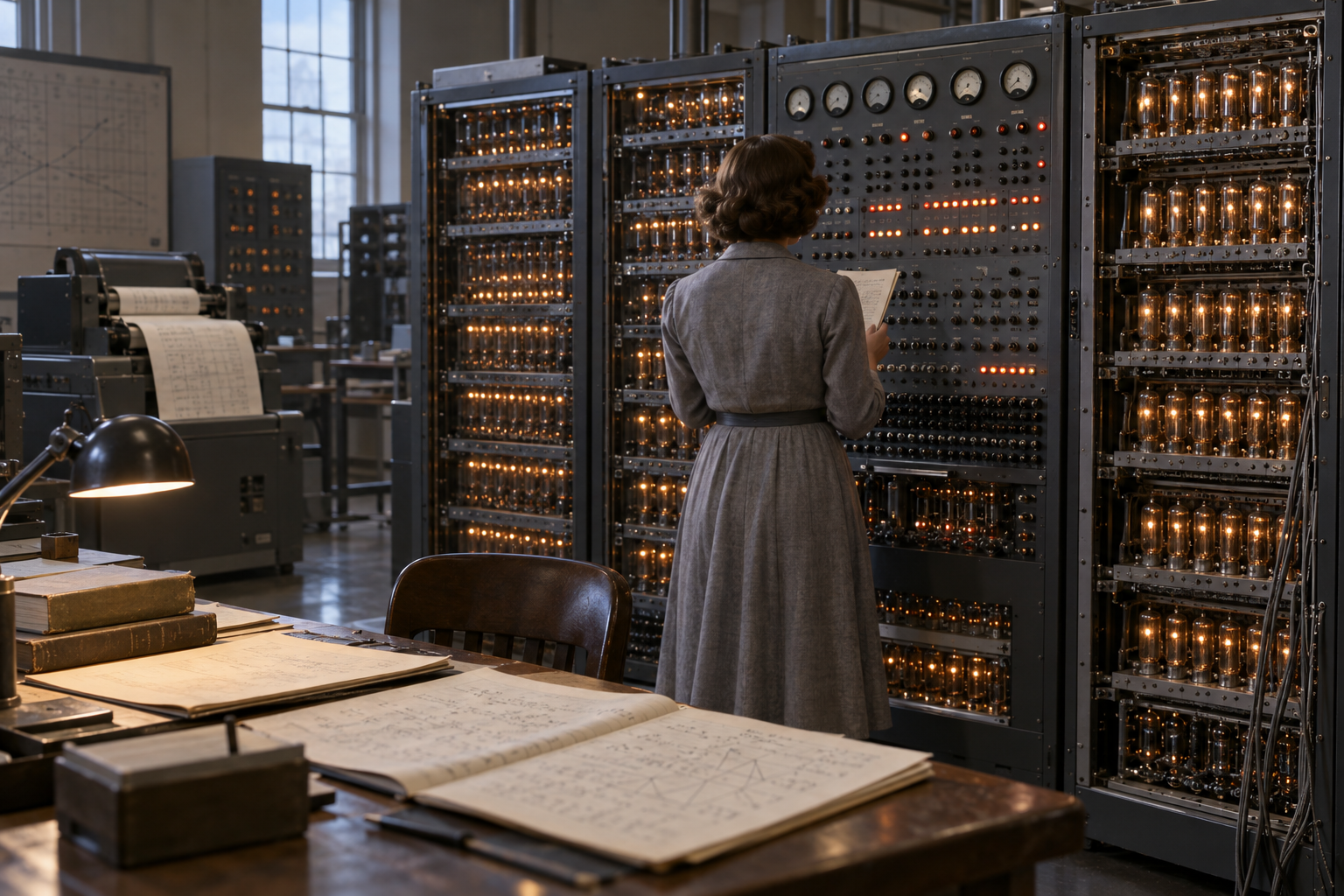
The established historical background is significant: Tsingou performed essential programming work for an early computer experiment that became a landmark in computational physics.

What was the experiment Mary Tsingou helped build?
At Los Alamos in the 1950s, Tsingou worked on a computer simulation associated with physicists Enrico Fermi, John Pasta and Stanislaw Ulam. The researchers investigated how energy moved among the modes of a system of coupled oscillators.
Instead of behaving as expected, the simulated system showed a surprising tendency to return towards its earlier state. The finding became important to the study of nonlinear systems and to the use of computers as tools for scientific discovery.

Why does the experiment now carry Tsingou’s name?
Long known as the Fermi–Pasta–Ulam problem, the experiment is also called the Fermi–Pasta–Ulam–Tsingou problem, explicitly recognising her contribution. Her role illustrates how the work required to turn a scientific question into a functioning computation can be obscured in later accounts of discovery.
The BharatVox View
For India’s expanding research ecosystem, the lesson is to make attribution accurate from the outset. Programmers, technical specialists and other contributors deserve recognition proportionate to their work, alongside the researchers who frame a problem.
Fair credit is both a duty to truth and a practical incentive for innovation. Universities, laboratories and private research enterprises should use clear contribution records rather than leave scientific memory to prestige or hierarchy.
Who's who
Mary Tsingou
Mathematician and programmer who contributed to the Fermi–Pasta–Ulam–Tsingou experiment
Frequently asked questions
Who is Mary Tsingou?
Mary Tsingou is a mathematician and computer programmer whose work at Los Alamos helped enable a landmark early experiment in computational physics.
What is the Fermi–Pasta–Ulam–Tsingou problem?
It concerns the unexpected behaviour of a simulated system of coupled oscillators, including a tendency to return towards an earlier state rather than distribute energy as initially expected.
Why was Mary Tsingou’s contribution important?
Her programming helped make the computer experiment possible. Including her name recognises that computational implementation was an essential part of the scientific work.
How long did Mary Tsingou wait for recognition?
The supplied source headline describes a wait of 50 years. The full report was not available to establish its precise chronology.
Fact-check this story · Originally reported by The Economic Times: Mary Tsingou's work took 50 years to credit. Reporting by BharatVox; any opinion is separately labelled.
Join the conversation (0)
Sign in to share your view on this story.