India’s Steel Demand Lifts Prices Against Global Weakness
Infrastructure investment, manufacturing growth and higher production costs are supporting Indian steel prices despite subdued overseas markets, according to a commodity-market assessment. Cheaper imports remain the main risk to that divergence.
BharatVox Telugu Desk · 17 Oct 2026 · మూలం: Economic Times Markets
ఈ కథనం భారత్వాక్స్ ఆంగ్ల మూలం నుండి తెలుగులోకి అనువదించబడింది. ఆంగ్ల మూలం చదవండి →
తెలుగు అనువాదం సిద్ధమవుతోంది… (మొదటిసారి కొద్దిగా సమయం పట్టవచ్చు)
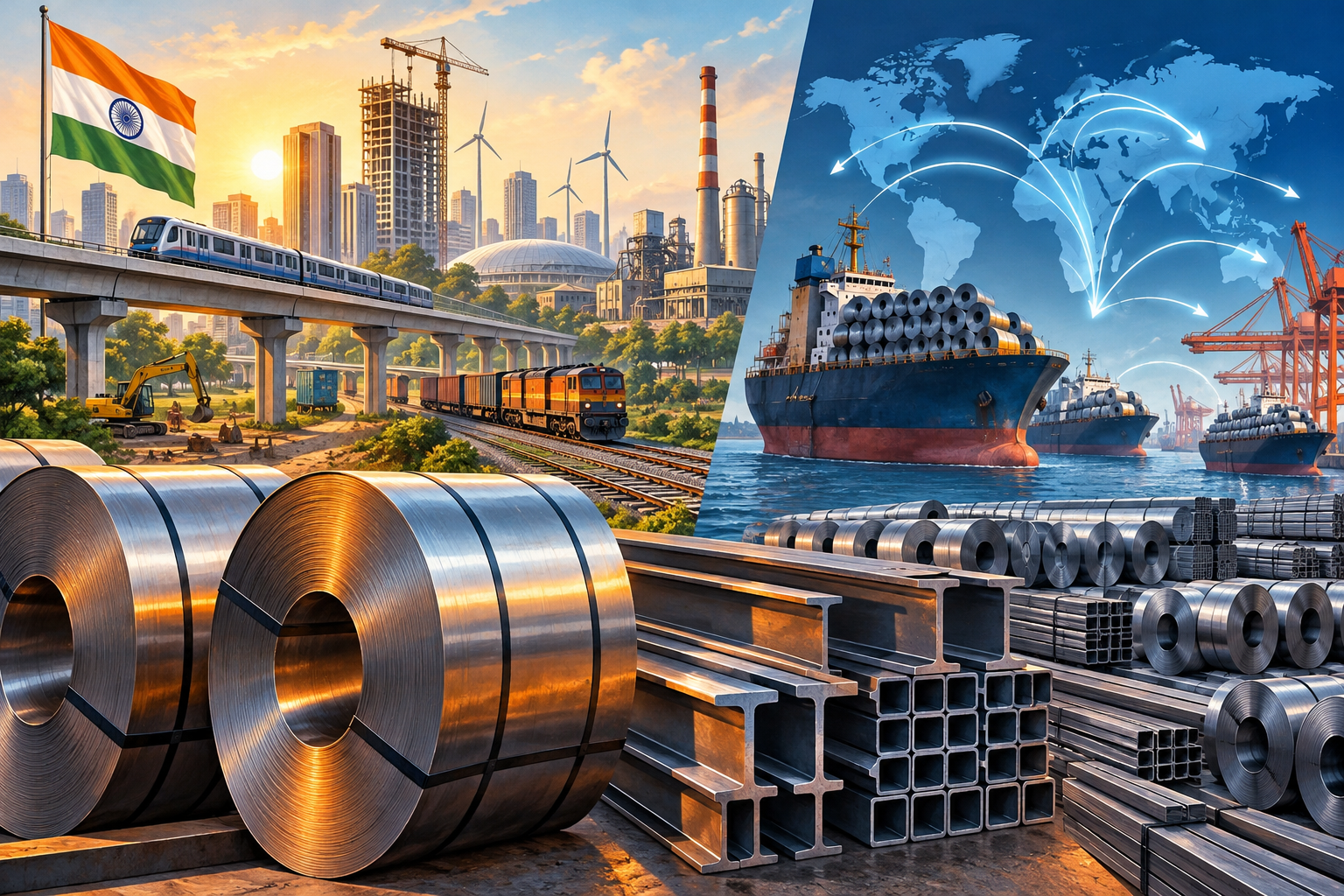
India’s steel prices have risen sharply this year even as international markets remain subdued, supported by infrastructure spending, expanding manufacturing and higher production costs, according to an October 17 assessment by Hareesh V, head of commodity research at Geojit Investments Limited, published in Economic Times Markets.
The assessment describes a domestic market in which consumption has broadly kept pace with new production capacity. Overseas, excess supply and weak demand—particularly in China—have held prices down. It is an expert market outlook rather than a quantified price survey; the article does not specify a steel-price benchmark or the size of the Indian increase.
Infrastructure and manufacturing drive consumption
Hareesh distinguishes the current upturn from the 2021–22 post-pandemic rally, when global supply disruptions and commodity inflation were major drivers. This time, he attributes the strength primarily to demand within India.
Investment in highways, railways, metros, ports and airports is increasing steel use, alongside renewable-energy facilities, defence infrastructure and industrial corridors. Manufacturing expansion under Make in India and production-linked incentive schemes is also supporting consumption, according to the assessment.
Automobiles, engineering goods, capital equipment and housing provide additional sources of demand. Together, these sectors have helped absorb expanded domestic output and sustain healthy capacity utilisation.
Higher costs also support domestic prices
The price rise is not solely a demand story. The assessment identifies increased expenses for coking coal, iron ore, electricity, freight and logistics as additional sources of upward pressure. Higher energy costs and disruptions along key shipping routes have also raised transportation expenses.
India, the world’s second-largest crude steel producer, has substantially increased output over the past decade. Yet imports remain important for value-added and specialty grades used in automotive and engineering applications.
Lower-priced supplies from China, South Korea and Japan challenge domestic producers. So far, Hareesh argues, strong Indian consumption has largely absorbed imported volumes without creating a significant market imbalance.
China’s supply-demand gap weighs on overseas markets
China’s prolonged property slowdown is central to the weaker international picture. Reduced housing starts, construction activity and real-estate investment have curtailed steel consumption, but production has not declined at the same pace, the assessment says.
Hareesh attributes continued operations at many Chinese mills partly to employment concerns and regional economic priorities. The resulting export volumes have intensified price competition across Asia, Europe, Africa and the Middle East.
Other major producing regions continue to supply substantial volumes. Europe faces weak manufacturing and high energy costs, while US demand remains below post-pandemic peaks despite infrastructure and industrial spending. Growth in India, Southeast Asia and parts of the Middle East has not been sufficient to offset the weakness in Chinese demand, according to the assessment.
Cheaper imports are the key risk
Hareesh’s outlook for India remains relatively positive: continued spending on transport, energy, defence, housing and manufacturing is expected to support steel consumption. He expects demand growth to limit the risk of major oversupply as domestic producers add capacity.
That outlook is conditional. A widening gap between Indian and overseas prices could attract a surge of cheaper imports, putting pressure on domestic producers.
For international prices, the assessment sees a stronger recovery as dependent on either a revival in Chinese demand or significant production cuts by major steel-producing countries. Neither outcome is presented as assured.
ఈ కథనం భారత్వాక్స్ ఆంగ్ల మూలం నుండి తెలుగులోకి అనువదించబడింది. ఆంగ్ల మూలం చదవండి →