Japan’s MMX launches towards Phobos for Mars moon sample mission
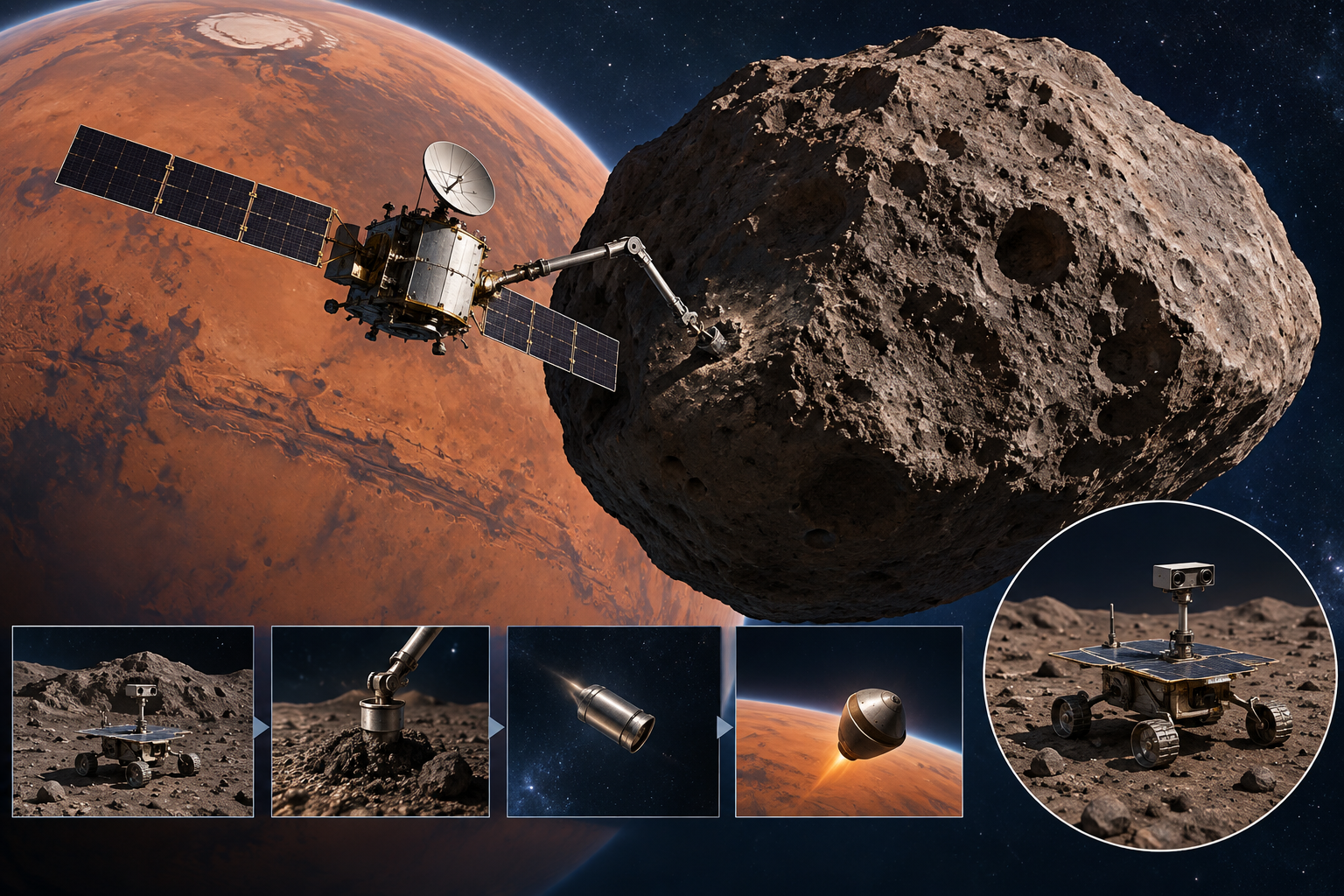
Japan’s MMX spacecraft has reportedly launched aboard an H3 rocket for a roughly 10-month journey to Mars. The JAXA-led mission aims to collect material from Phobos and return it to Earth in 2031, potentially helping explain how Mars’ two moons formed.
BharatVox Telugu Desk · 19 Oct 2026 · మూలం: India Today
ఈ కథనం భారత్వాక్స్ ఆంగ్ల మూలం నుండి తెలుగులోకి అనువదించబడింది. ఆంగ్ల మూలం చదవండి →
తెలుగు అనువాదం సిద్ధమవుతోంది… (మొదటిసారి కొద్దిగా సమయం పట్టవచ్చు)
Japan’s Martian Moons eXploration spacecraft has launched aboard an H3 rocket from the Tanegashima Space Centre, India Today reported. The Japan Aerospace Exploration Agency-led mission is expected to reach Mars in August 2027 after a journey of about 10 months, before surveying its moons and attempting to collect material from Phobos.
The mission’s central objective is to bring at least 10 grams of Phobos surface material back to Earth in 2031. If successful, MMX would deliver the first samples retrieved from a moon of Mars.
Testing two explanations for Mars’ moons
Phobos and Deimos pose a fundamental question about the Martian system: were they once asteroids captured by the planet’s gravity, or did they form from debris thrown out by a massive collision involving Mars?
MMX will examine Phobos’ surface, composition, internal structure and gravity to help distinguish between these explanations. It will also observe Deimos, the smaller and more distant of Mars’ two moons.
The spacecraft is expected to enter a quasi-satellite orbit around Phobos, enabling close observations and the selection of suitable sampling sites. The mission plan includes two landing operations as part of its exploration and sample-collection work.
A rover and instruments will guide the investigation
MMX will deploy Idefix, a small rover jointly developed by France’s space agency CNES and the German Aerospace Center, DLR. Its investigation of the surface will help researchers assess the terrain and the conditions the main spacecraft may encounter during sampling.
International partners include NASA, the European Space Agency, CNES and DLR. NASA’s contributions include MEGANE, a gamma-ray and neutron spectrometer designed to help identify the elemental composition of Phobos’ surface.
Samples targeted for recovery in Australia
After completing its observations and sample collection, MMX is scheduled to leave the Martian system for Earth. Its sample capsule is expected to separate from the spacecraft and enter Earth’s atmosphere in 2031, with recovery planned in Australia.
The arrival, collection and return milestones remain mission targets, not completed achievements. Material recovered from Phobos could offer clues to the origins of both Martian moons, Mars’ evolution and the processes that shaped the early solar system.
ఈ కథనం భారత్వాక్స్ ఆంగ్ల మూలం నుండి తెలుగులోకి అనువదించబడింది. ఆంగ్ల మూలం చదవండి →