Japan’s MMX mission targets Phobos samples for return to Earth
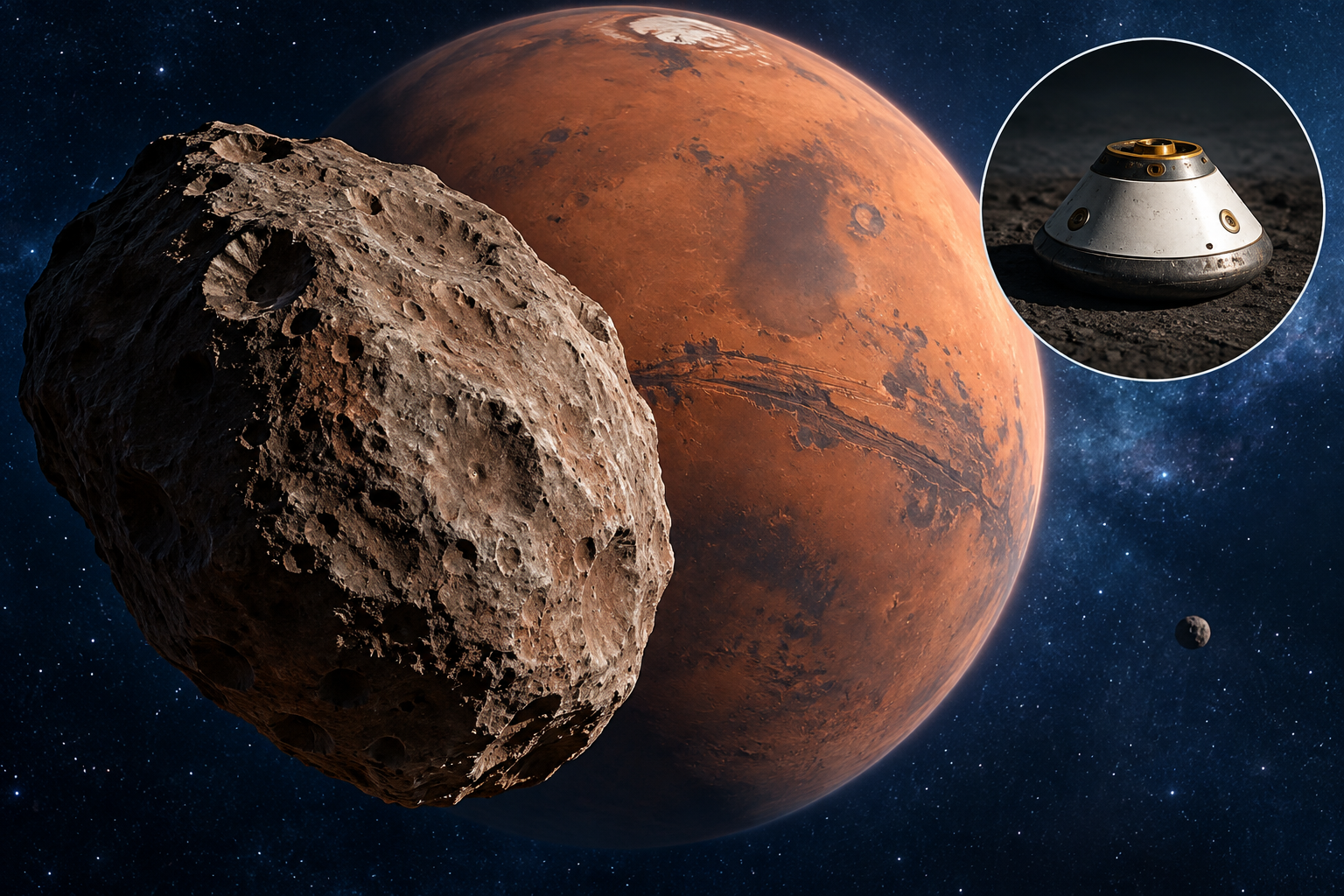
Japan’s planned Martian Moons eXploration mission will study Phobos and Deimos and attempt to bring at least 10 grams of Phobos material to Earth. The samples could help explain how Mars’ moons formed.
BharatVox Telugu Desk · 19 Oct 2026 · మూలం: India Today
ఈ కథనం భారత్వాక్స్ ఆంగ్ల మూలం నుండి తెలుగులోకి అనువదించబడింది. ఆంగ్ల మూలం చదవండి →
తెలుగు అనువాదం సిద్ధమవుతోంది… (మొదటిసారి కొద్దిగా సమయం పట్టవచ్చు)
Japan’s space agency is preparing to launch a mission to collect material from Phobos, one of Mars’ two moons, with a planned return to Earth in 2031. India Today reports that the Japan Aerospace Exploration Agency’s Martian Moons eXploration mission, or MMX, is scheduled to lift off at 1:11 am IST aboard an H3 rocket from the Tanegashima Space Centre.
The reported schedule is a pre-launch update, not confirmation of liftoff. The mission aims to retrieve at least 10 grams of material from Phobos and investigate whether the Martian moons began as captured asteroids or formed from debris after a powerful impact on Mars.
A rover will scout the surface
MMX will carry 13 scientific instruments to examine Phobos’ surface, composition, internal structure and gravity. It will also observe Deimos, Mars’ smaller moon, from a distance.
Its payload includes IDEFIX, a small rover developed by France’s CNES and Germany’s DLR. The rover is intended to explore Phobos’ terrain before the main spacecraft attempts to collect samples.
The spacecraft is expected to reach the Martian system in August 2027 and spend roughly three years investigating the moons. Its sampling approach is designed to gather both loose surface material and grains from greater depth, then seal them inside a capsule for the return journey.
Testing two explanations for Phobos’ origins
Phobos is irregularly shaped and circles very close to Mars. Its origins remain disputed: one explanation is that Mars captured an asteroid through its gravity; another is that the moon assembled from material ejected by a major collision with the planet.
Laboratory analysis on Earth could help distinguish between those explanations. Researchers also hope the samples may contain material blasted off Mars by ancient impacts, offering another route to studying the planet’s early history.
If the collection and return succeed, MMX would deliver the first samples brought to Earth from a Martian moon. The 2031 return remains a mission target, rather than an assured outcome.
ఈ కథనం భారత్వాక్స్ ఆంగ్ల మూలం నుండి తెలుగులోకి అనువదించబడింది. ఆంగ్ల మూలం చదవండి →