Japan launches MMX mission to bring Phobos samples to Earth
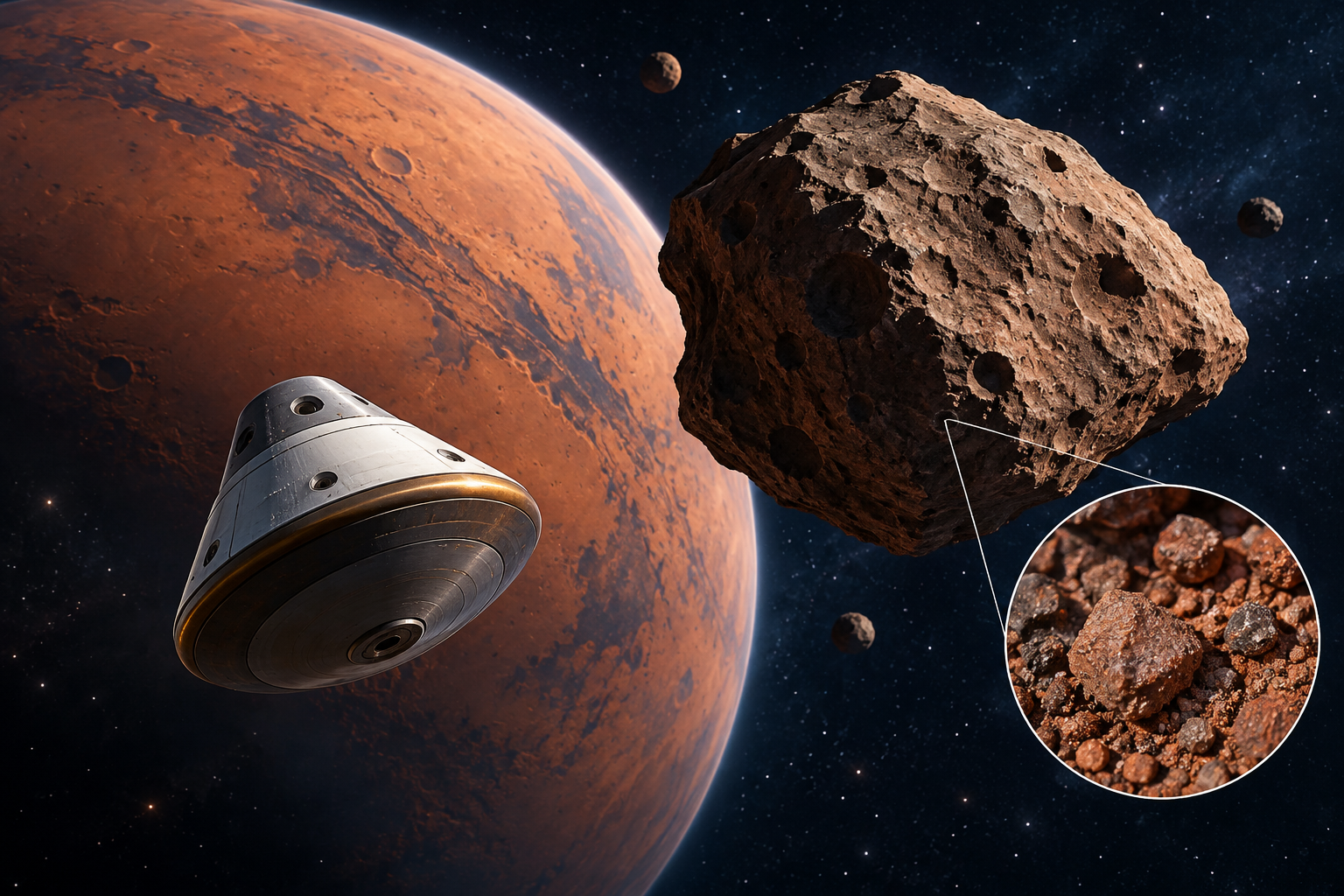
Japan’s MMX spacecraft has launched towards Mars, with plans to investigate Phobos and return at least 10 grams of its surface material in 2031. The mission seeks to clarify how the Martian moon formed.
BharatVox Telugu Desk · 20 Oct 2026 · మూలం: RT
ఈ కథనం భారత్వాక్స్ ఆంగ్ల మూలం నుండి తెలుగులోకి అనువదించబడింది. ఆంగ్ల మూలం చదవండి →
తెలుగు అనువాదం సిద్ధమవుతోంది… (మొదటిసారి కొద్దిగా సమయం పట్టవచ్చు)
Japan launched its Martian Moons eXploration (MMX) spacecraft aboard an H3 rocket from Tanegashima Space Center on October 19, aiming to achieve the first successful landing on a Martian moon and bring samples back to Earth. RT reported the launch, citing a live broadcast by the Japan Aerospace Exploration Agency (JAXA).
The mission targets Phobos, the larger of Mars’ two moons. If its operations succeed, MMX will deliver at least 10 grams of surface material to Earth in 2031. That remains a mission objective, not an accomplished sample return.
A rover will scout the surface before sample collection
JAXA’s schedule calls for MMX to reach Mars in August or September 2027 and begin observations. A French-German rover named IDEFIX is due to be deployed on Phobos in late 2028 or early 2029.
The 25-kilogram rover will be released onto the moon to examine its surface for about 100 days. The main spacecraft is then expected to attempt two landings to gather material.
MMX also has a planned flyby of Deimos, Mars’ smaller moon, in 2030, before its return module begins the journey to Earth.
Why operating near Phobos is difficult
Phobos is only 27 kilometres across at its longest dimension. Its weak gravity makes a conventional close orbit impractical for the mission.
Instead, MMX will orbit Mars in step with Phobos, maintaining what is known as a quasi-satellite relationship with the moon. This approach allows the spacecraft to operate near its target without relying on a conventional orbit around Phobos.
The samples could help scientists distinguish between two explanations for the moon’s origin: that it assembled from debris expelled by a major impact on Mars, or that it was once an asteroid captured by the planet’s gravity.
Earlier attempts never reached a successful landing
Neither Phobos nor Deimos has received a successful spacecraft landing. Two Soviet probes launched in 1988 failed to complete their missions, although one conducted observations near Mars.
Phobos 1 was lost en route after an incorrect ground command disabled its attitude-control system. Phobos 2 observed Mars and Phobos for nearly two months, but a communications failure prevented it from deploying its two small landers.
Russia’s Fobos-Grunt mission also failed in 2011, when a propulsion failure left the spacecraft unable to depart Earth orbit for Mars. MMX now seeks to overcome the technical barriers that defeated those earlier efforts.
ఈ కథనం భారత్వాక్స్ ఆంగ్ల మూలం నుండి తెలుగులోకి అనువదించబడింది. ఆంగ్ల మూలం చదవండి →