Stubble burning: Can straw sales make farms more profitable?
A farmer near Sonipat sells paddy straw for Rs 1,500 an acre instead of burning it. Research cited in the reporting shows why expanding that business requires affordable transport, safer storage and reliable buyers—and why mushrooms and biogas cannot absorb all the residue.
BharatVox Telugu Desk · 2 hr ago · మూలం: India Today
ఈ కథనం భారత్వాక్స్ ఆంగ్ల మూలం నుండి తెలుగులోకి అనువదించబడింది. ఆంగ్ల మూలం చదవండి →
తెలుగు అనువాదం సిద్ధమవుతోంది… (మొదటిసారి కొద్దిగా సమయం పట్టవచ్చు)
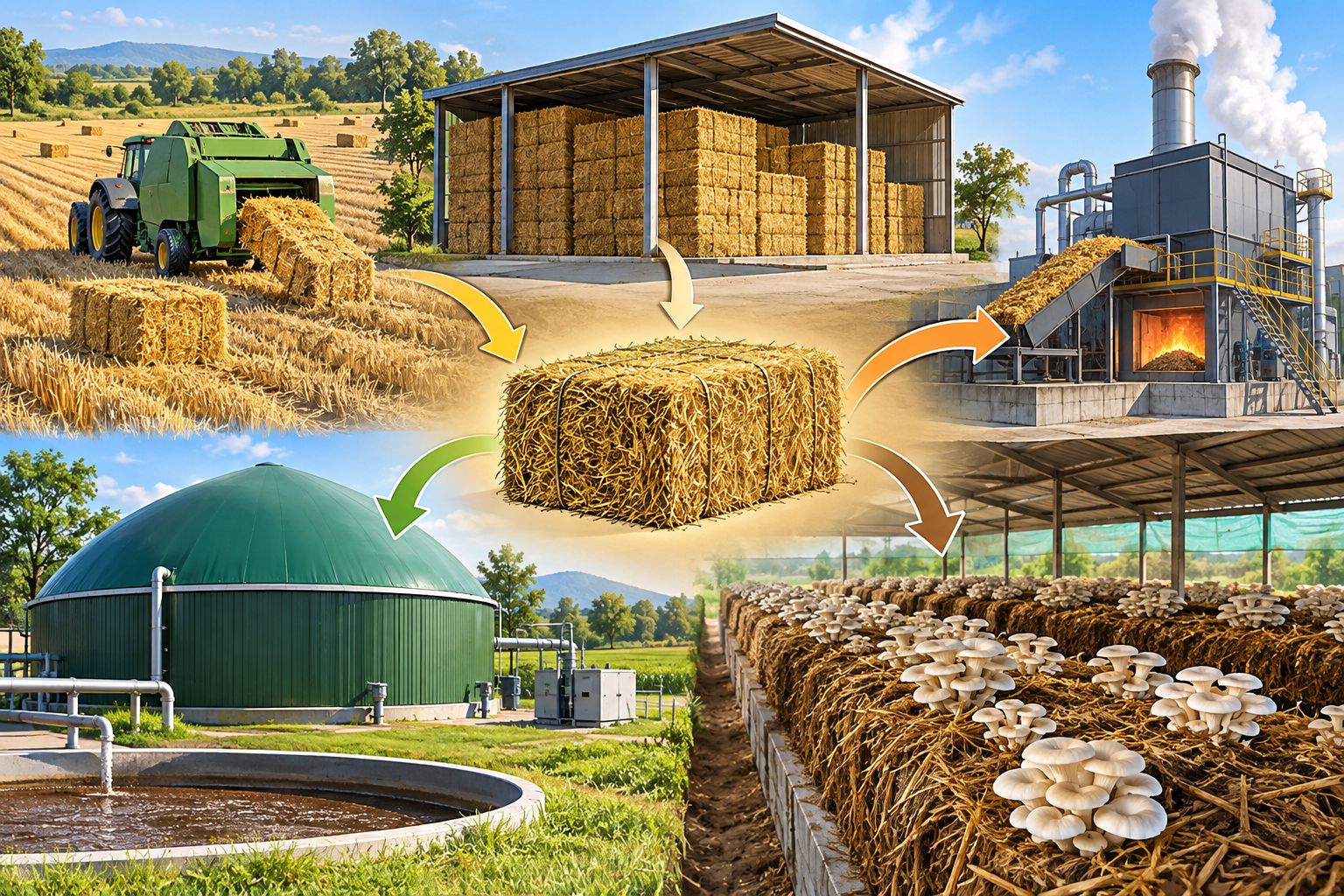
A farmer near Sonipat who grows paddy on 15 acres has replaced burning with baling, selling his straw to a company for Rs 1,500 an acre. His experience, described in India Today's October 23 report through an account originally given to Kisan Tak, illustrates a commercial alternative to crop-residue fires—but one still constrained by costly transport, storage losses and uneven payments to growers.
A baby corn processing unit offers another outlet: its manager said the factory purchases straw for Rs 1,000–1,500 an acre and burns it in a boiler instead of wood. Such off-site use, known as ex-situ management, can turn a disposal burden into a saleable input.
The potential supply is enormous. Dr BL Attri, acting director of the ICAR-Directorate of Mushroom Research in Solan, estimates that India generates 125–140 million tonnes of paddy straw annually, of which 35–40 million tonnes is burned. Finding uses for that volume requires more than machines to collect it.
The costly journey from field to factory
Straw is bulky, expensive to haul and collected within a tight harvest-to-sowing interval. Much of the supply arrives within the same 15–20 days across a state, leaving buyers needing enough storage to carry a seasonal material into year-round industrial use.
A 2021 Punjab case study by the Council on Energy, Environment and Water (CEEW), authored by LS Kurinji and Sankalp Kumar, estimated that baling straw and transporting it to a local storage yard within roughly 15 km cost about Rs 1,330 a tonne. Delivery to a buyer 50 km away cost approximately Rs 2,950 a tonne. Beyond that distance, the study found, the business was often uneconomic. These are historical estimates, not current freight quotations.
The same study used 2018 figures showing Punjab produced about 20 million tonnes of paddy straw, burned roughly 13 million tonnes in fields and sent only around 1.1 million tonnes to off-site buyers. Those figures describe the market at that time, rather than its present size.
Storage losses weaken the farmer's bargain
CEEW's September 2025 report on paddy straw storage, by Ayushman Saboo, Kurinji Kemanth and Harsha Arya, surveyed eight straw-buying and storage companies in Punjab. Seven reported annual losses of 15–25 per cent, mainly during storage. Five had experienced fires; four of those did not know the cause.
The loss estimates were reported verbally by the companies rather than measured, an important limitation in interpreting the findings. Moisture presented another difficulty: industries sought straw with moisture below 20 per cent, while some firms received bales with levels as high as 40 per cent.
The report also said storage costs were not incorporated into procurement prices and farmers often received little or nothing for their straw. The paying arrangements described near Sonipat therefore should not be treated as typical of the wider market.
According to CEEW, Punjab aims to handle six million tonnes of its approximately 20 million tonnes of annual straw production through off-site uses. Accommodating that target would require an estimated 4,200–5,580 acres of storage yards. The target is not evidence that this volume is already being processed.
Biogas has a feedstock challenge as well as a capacity gap
Paddy straw can supply biogas plants, where microbes digest organic material without oxygen. The resulting methane-rich gas can be purified and compressed for use as fuel. However, straw's composition makes it harder to process than its abundance might suggest.
Dr Sandeep Sharma, a soil microbiologist at Punjab Agricultural University, explained that lignin, silica and a high carbon-to-nitrogen ratio slow decomposition. A 2022 review in Environmental Research similarly identified high lignin and silica content as obstacles to digestibility in biogas production.
CEEW's 2021 study identified eight bio-CNG projects in Punjab with potential annual straw use of about three lakh tonnes. That was prospective utilisation, not a reported quantity actually consumed, and was small relative to the state's historical burning volumes.
Mushrooms can add value, where conditions suit them
Fungi offer another route because they can break down the tough plant fibres in straw. Attri identified paddy straw mushroom, Volvariella volvacea, as a principal species grown on the material, while oyster and button mushrooms can also use it.
He estimated that a bed containing 30 kg of dry paddy straw typically yields 4–5 kg of fresh paddy straw mushrooms. Preparation involves soaking the straw to around 65–70 per cent moisture and pasteurising it before adding spawn. After harvesting, the remaining growing material can be composted.
Scientists at the ICAR-National Rice Research Institute in Cuttack reported in Indian Farming in 2022 that an operation producing paddy straw mushrooms on 4,000 beds annually could net Rs 3 lakh, with another Rs 1.36 lakh from vermicompost made using the spent material. These are reported enterprise estimates, not guaranteed returns for every grower.
Climate limits the crop's usefulness in the northern harvest season. Paddy straw mushrooms require approximately 30–35°C, Attri said, making them more suitable for coastal Odisha, West Bengal and Andhra Pradesh than Punjab's cooler autumn.
A 2019 survey published in Mushroom Research found that Odisha produced 9,550 tonnes of straw mushrooms in 2015–16. Growers averaged only about 10 per cent biological efficiency—the fresh mushroom weight relative to dry straw weight—with poor spawn, contamination and weak marketing of a perishable product holding them back.
Food safety also matters. Attri warned that fungi can concentrate contaminants from their growing material, including persistent herbicides and heavy metals such as lead, cadmium and arsenic. Straw selection therefore matters alongside production costs.
Even with strong support, Attri estimates mushroom cultivation could absorb only 8–12 per cent of a region's straw burden. He sees it as a complement to larger-volume uses such as biomass pellets, second-generation biofuels and industrial packaging materials, rather than a replacement for them.
Selling every stalk is not necessarily best for the soil
Removing residue also has an agronomic cost. The director of ICAR's Agricultural Technology Application Research Institute in Ludhiana said retaining straw supports soil moisture, microbial activity and nutrient cycling, with long-term trials showing improvements in soil health and crop productivity.
Retention has environmental trade-offs of its own. A 2023 review in Nature Reviews Earth & Environment found that adding straw increased methane emissions from rice fields by 92 per cent on average compared with removing it. That figure concerns methane, not the complete environmental balance of residue management.
Sharma emphasised that the overall outcome depends on water management, other greenhouse gases, air pollution and soil-carbon gains. He also cited a 2024 BioResources study he co-authored indicating that native soil microbes can decompose incorporated straw when farmers have about three weeks available. Timing and field conditions therefore help determine whether retention or removal is more practical.
Fewer fires would help Delhi, but not eliminate its pollution
A 2025 study cited in the reporting estimated that crop burning contributed 18 per cent of PM2.5 in Delhi and surrounding areas during October 16–November 30 in 2022, compared with 16 per cent in 2023 and 9 per cent in 2024. On brief episodes when winds carried smoke directly from burning areas, the contribution reached about 50 per cent for two or three days at a time.
These seasonal and episodic estimates should not be read as annual pollution shares. They indicate that reducing fires can substantially improve some of the worst smoke episodes, while Delhi's other pollution sources still require attention.
For farmers, the immediate commercial question remains whether a buyer can collect straw on time and pay enough to make the transaction worthwhile. The reported examples show that sales are possible; the storage and transport studies explain why a dependable market needs collection networks, dry storage and viable contracts as well as end-use technology.
ఈ కథనం భారత్వాక్స్ ఆంగ్ల మూలం నుండి తెలుగులోకి అనువదించబడింది. ఆంగ్ల మూలం చదవండి →