BRAZIL ELECTION
Amazon Deforestation Falls 41.8%, Brazil Says, Before Run-Off
Brazil’s government says Amazon deforestation recorded its biggest annual percentage decline since monitoring records began in 1988. The announcement comes before a presidential run-off that puts competing approaches to forest protection before voters.
BharatVox ·
A record decline before a closely contested vote
Brazil’s government says deforestation in its Amazon rainforest and Cerrado savanna has reached record lows, placing environmental protection at the centre of the country’s approaching presidential run-off. The announcement gives President Luiz Inácio Lula da Silva a substantial result to present to voters as he seeks to defend his forest policies.
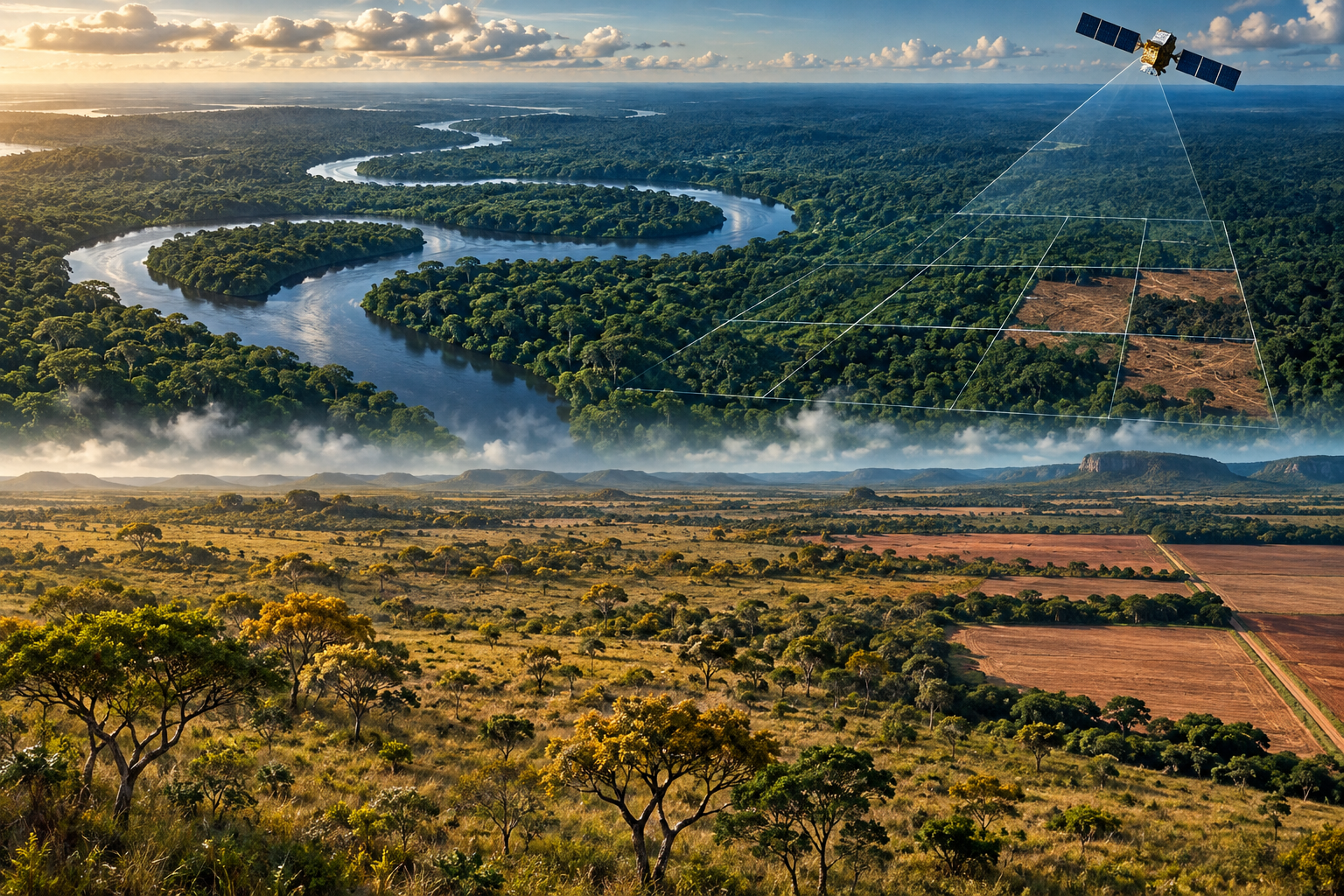
Satellite data cited in the announcement showed Amazon deforestation falling 41.8% in the year to July 2026, the largest percentage decline in a series dating back to 1988. The corresponding fall in the Cerrado was 23.8%. BBC News reported the figures and the government’s assessment.
The distinction between a lower rate of destruction and an end to destruction remains important. These figures describe a reduction in deforestation; they do not establish that forest clearance has stopped or that previously cleared land has recovered. Lula’s stated target remains zero illegal deforestation by 2030.
BharatVox Graphic
Reported deforestation declines
Decline in the year to July 2026, reported as the largest since records began in 1988.
Decline in Brazil’s savanna region over the same reporting year.
Two political paths for the rainforest
Lula is due to face Flavio Bolsonaro, son of former president Jair Bolsonaro, in the run-off on 25 October. Polling described in the report suggests a closely matched contest, leaving the future direction of Brazil’s forest policy uncertain despite the latest environmental figures.
Flavio is expected to maintain his father’s policy approach if elected, although that expectation should not be read as a detailed account of every measure he would adopt. He has also pledged to confront organised crime in the Amazon. The supplied report does not set out how that promise would translate into forest enforcement or environmental regulation.
The contrast rests partly on the record of Jair Bolsonaro’s 2019–2022 presidency. He encouraged mining on indigenous lands, while forest clearance increased and resources for protecting the rainforest were reduced. Official figures cited in the reporting showed Amazon forest loss during those four years was nearly 60% greater than in the preceding four-year period.
That historical comparison is different from the latest annual decline. One measures forest loss across two presidential-length periods; the other measures the change in the deforestation rate over a single year. They should not be treated as directly interchangeable indicators.
Lula’s enforcement record and the remaining target
After taking office three years ago, Lula reversed his predecessor’s approach, strengthened environmental monitoring and increased penalties for illegal logging. Deforestation fell to a six-year low during his first year in office, according to the report.
The latest figures extend that reported improvement. On Friday, Lula reiterated on X that his goal was to eliminate illegal deforestation by 2030. The qualification matters: the commitment he restated concerns illegal clearance, rather than a promise that every form of forest removal will cease.
Environment Minister Joao Paulo Capobianco welcomed the scale of the decline. Marcio Astrini, executive secretary of the climate advocacy organisation Observatorio do Clima, also praised the result and argued that it demonstrated the importance of political commitment in reducing deforestation and greenhouse-gas emissions.
Those reactions are assessments of the outcome, not additional measurements. The central numerical evidence remains the satellite-based decline reported for the year to July. Whether the improvement continues will be a key test of the distance still separating the current result from the 2030 objective.
Why the Amazon matters beyond Brazil
The Amazon is the world’s largest tropical rainforest, and approximately 60% of it lies within Brazil. Its significance extends beyond national borders because healthy tropical forests absorb large quantities of carbon dioxide, helping moderate global warming, while supporting millions of species.
Decades of clearance for agriculture and logging have put those ecosystems under pressure. Climate change adds another strain: scientists warn that it can create conditions favourable to wildfires. A reduction in deliberate clearance therefore addresses an important threat, but is not evidence that every risk to the forest has receded.
The Cerrado figures also deserve attention alongside the Amazon headline. The reported 23.8% reduction concerns Brazil’s savanna region, showing that the government’s announcement covers two distinct landscapes rather than the rainforest alone.
Analysis: India’s interest, Brazil’s decision
For India, the relevance of this election is the Amazon’s contribution to the global climate balance. That gives the reported decline international importance without diminishing Brazil’s sovereignty: the choice between candidates and their competing approaches belongs to Brazilian voters.
The practical lesson is narrower than a political endorsement. Monitoring, enforceable rules and measurable outcomes offer a sound basis for judging environmental policy. The next milestones are the 25 October vote and whether subsequent forest data sustain the improvement. A record annual decline is consequential, but it is not yet fulfilment of the 2030 pledge.
How it unfolded
Timeline
2019–2022
Jair Bolsonaro’s presidency saw increased Amazon forest loss and reduced resources for forest protection, according to the report.
July 2026
The reporting year ended with a 41.8% decline in Amazon deforestation and a 23.8% decline in the Cerrado.
25 October 2026
Lula and Flavio Bolsonaro are scheduled to contest the presidential run-off.
2030
Target year for Lula’s commitment to zero illegal deforestation.
Who's who
Luiz Inácio Lula da Silva
Brazilian president and presidential run-off candidate
Flavio Bolsonaro
Presidential run-off candidate and son of Jair Bolsonaro
Jair Bolsonaro
Former Brazilian president, in office from 2019 to 2022
Joao Paulo Capobianco
Brazil’s environment minister, as identified in the source
Marcio Astrini
Executive secretary of Observatorio do Clima
Fact-check this story · Source: BBC News: Brazil sees record fall in Amazon deforestation as key election looms. This AI-assisted account is based on the linked source, not independent on-the-ground reporting by BharatVox. Any opinion is separately labelled.
Join the conversation (0)
Sign in to share your view on this story.