PUBLIC HEALTH
Bangladesh measles outbreak exposes deadly vaccination gaps
Bangladesh recorded 202,000 suspected measles cases from mid-March to October 9, with children under five accounting for 94% of reported deaths. Reuters reporting links the crisis to falling vaccination coverage, unreliable target lists and failures to reach vulnerable families.
BharatVox ·
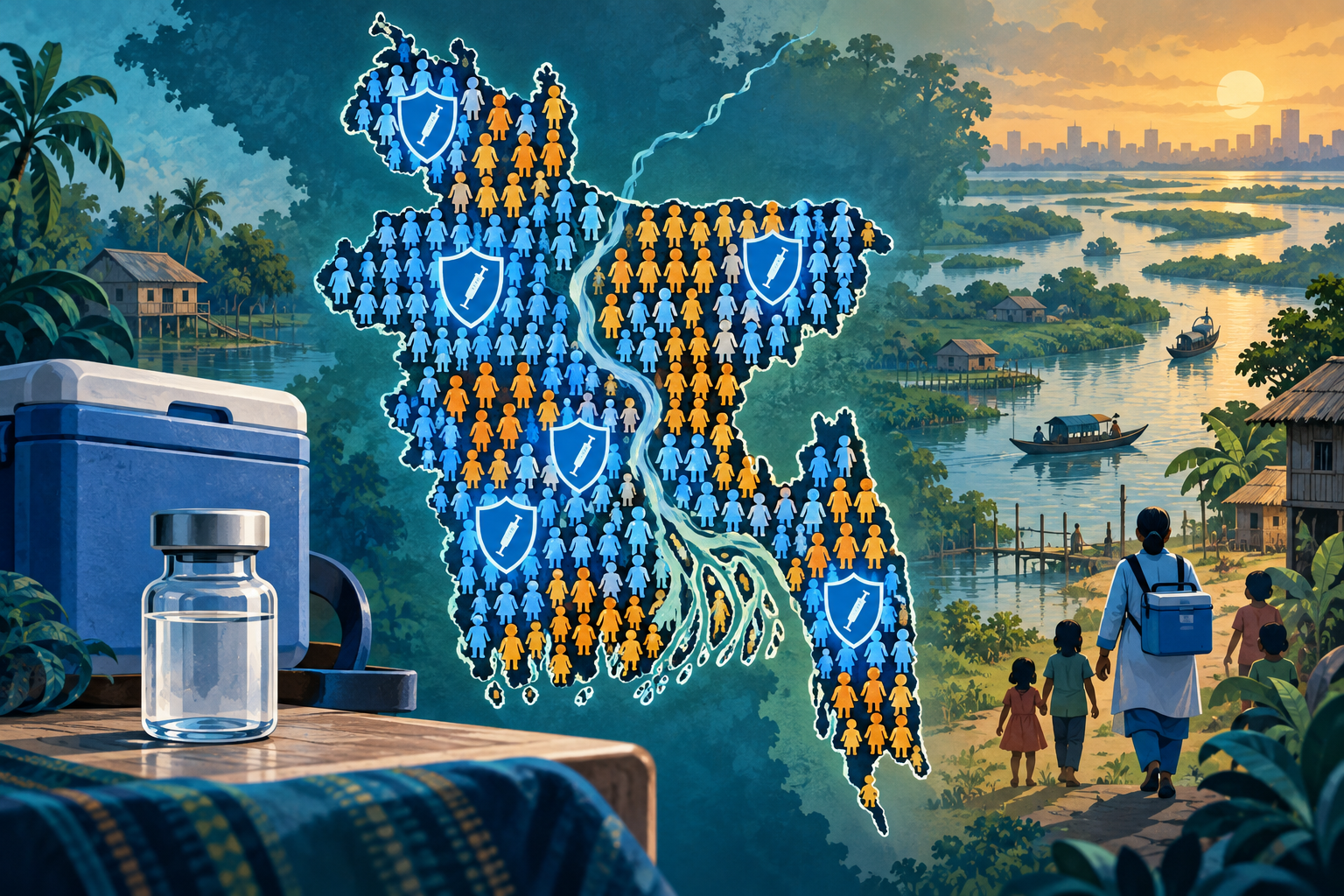
Bangladesh has reported 202,000 suspected measles cases and 1,147 deaths during an outbreak that began in mid-March, with children under five accounting for 94% of reported deaths, according to World Health Organization figures through October 9. Of the suspected infections, 22,000 were laboratory-confirmed; the country's suspected-case total was the highest reported anywhere this year.
A Reuters investigation carried by The Economic Times found that falling routine vaccination coverage was compounded by inaccurate population estimates, compressed emergency preparations and outreach that failed to reach vulnerable families. Its findings draw on WHO documents and interviews with scientists, health workers and officials.
An April–May emergency drive vaccinated almost 20 million children and initially slowed infections. But cases subsequently rose again: Bangladesh reported a daily average of 1,198 new cases in September, its highest level since May.
BharatVox Graphic
Measles vaccination coverage fell in 2025
Estimated coverage exceeded the WHO's 95% outbreak-prevention benchmark.
Estimated coverage fell six percentage points from 2024.
Estimated coverage was already below the 95% benchmark.
Estimated coverage fell seven percentage points from 2024.
Routine protection weakened before the outbreak
Bangladesh had previously achieved high childhood vaccination coverage. WHO and UNICEF estimated that in 2024, 96% of children received a first measles vaccine dose and 93% received a second. The second dose protects children who do not develop immunity after their first shot.
Those estimates fell to 90% and 86%, respectively, in 2025—below the 95% coverage level the WHO says is needed to prevent outbreaks. Following the political turmoil surrounding the end of Sheikh Hasina's rule in 2024, health-worker strikes, delayed vaccine orders and disrupted follow-up vaccinations weakened the programme, Reuters reported.
A WHO–UNICEF report published in July also questioned vaccination data for 2023–2025. Some preliminary figures put the number of people vaccinated above 100% of the target population, suggesting errors in dose counts or estimates of how many children needed protection.
Mark Jit, a WHO vaccine adviser and professor at New York University's School of Global Public Health, described Bangladesh's experience as a warning to other countries. He said preventing outbreaks through vaccination was less costly and safer than trying to contain them once infections were spreading.
Emergency target lists left a large gap
After the April–May campaign, the government said it had reached every child in its target group, aged six months to five years. Yet a separate routine health intervention in June listed 4 million more children in the same age bracket.
Ziauddin Hyder, special assistant on health affairs to Prime Minister Tarique Rahman, acknowledged a gap in a September 14 interview with Reuters. He attributed some missed vaccinations to parental hesitancy or children being ill. Experts interviewed for the report, however, identified access and awareness as bigger obstacles in Bangladesh.
Minutes of an April 19 meeting between the government, WHO and other health partners showed that officials chose one round of readiness checks rather than the usual four because of time constraints. These checks assess practical requirements such as refrigeration and the number of children to be vaccinated. The single round indicated that most districts, but not all, were ready.
Hyder said the campaign was organised in four weeks. Tajul Islam Abdul Bari, who led Bangladesh's immunisation programme until 2017, said such drives ordinarily required months of preparation.
By August, meeting records showed that the share of confirmed measles cases involving unvaccinated children remained similarly high before and after the campaign: 82% and 85%, respectively. Those figures describe children with confirmed infections, not vaccination coverage across the wider population.
Families describe help arriving too late
In the northeastern Sylhet region, two-year-old Arman Hossain died in July, 24 hours after being admitted to hospital. His family sold its three-wheeled auto rickshaw to pay for treatment. His father, Amin Mia, told Reuters that vaccination workers reached their remote village only after the boy's burial. Arman's four-year-old sister, also unvaccinated, survived.
In Chhatak, nine-month-old Labiba Akter died unvaccinated in June. She had become eligible for a shot when the emergency programme lowered the minimum vaccination age from nine months to six months in April. Her father, carpenter Humayun Rashid, said no health worker had informed the family.
Official records cited in the report showed 180 child deaths in Sylhet. Of 16 families Reuters interviewed there in September, eight said they had not seen health workers offering vaccinations. At least six said workers came only after a child in their community had died from measles.
Professor Mahmudur Rahman, chair of Bangladesh's National Verification Committee for Measles and Rubella Elimination, said inadequate preparation disproportionately leaves poor and difficult-to-reach children without protection.
Renewed campaign faces staffing and registration barriers
At the end of September, the government launched another campaign targeting 3.4 million previously missed children. Health Minister Sardar Md. Sakhawat Husain pledged to involve village communities to extend its reach. In May, he had said the outbreak was under control and cases in hotspots had fallen almost to zero.
Identifying and reaching every eligible child remains difficult. UNICEF and the Bangladesh Bureau of Statistics estimate that as many as 40% of children are unregistered, while government figures show roughly a third of health-worker posts are vacant.
Health experts are also urging authorities to include children older than five, who account for a third of measles cases, according to the WHO. Separately, scientists in Bangladesh are investigating why protection from maternal antibodies appears to be fading sooner than expected in very young babies.
The outbreak is straining medical services while Bangladesh also confronts dengue. During a Reuters visit in September, Sylhet's 100-bed Shahid Shamsuddin Ahmed Hospital had 178 admitted patients.
Hyder told Reuters in September that the government was doing everything possible to end the outbreak; it did not answer further questions sent in October. The WHO did not answer questions about the April and August meetings. Its deputy representative in Bangladesh, Dr Rajesh Narwal, said the organisation was supporting efforts to vaccinate every child at risk and strengthen routine immunisation.
Fact-check this story · Source: The Economic Times: Bangladesh's measles outbreak is a 'real warning'. This AI-assisted account is based on the linked source, not independent on-the-ground reporting by BharatVox. Any opinion is separately labelled.
Join the conversation (0)
Sign in to share your view on this story.