EURO AREA
ECB’s Lane: Energy shock drives policy as bond yields rise
Philip Lane says the energy shock remains the main driver of ECB interest-rate decisions, while higher long-term borrowing costs could weaken growth and inflation. He called for targeted help for low-income households rather than broad fiscal expansion.
BharatVox ·
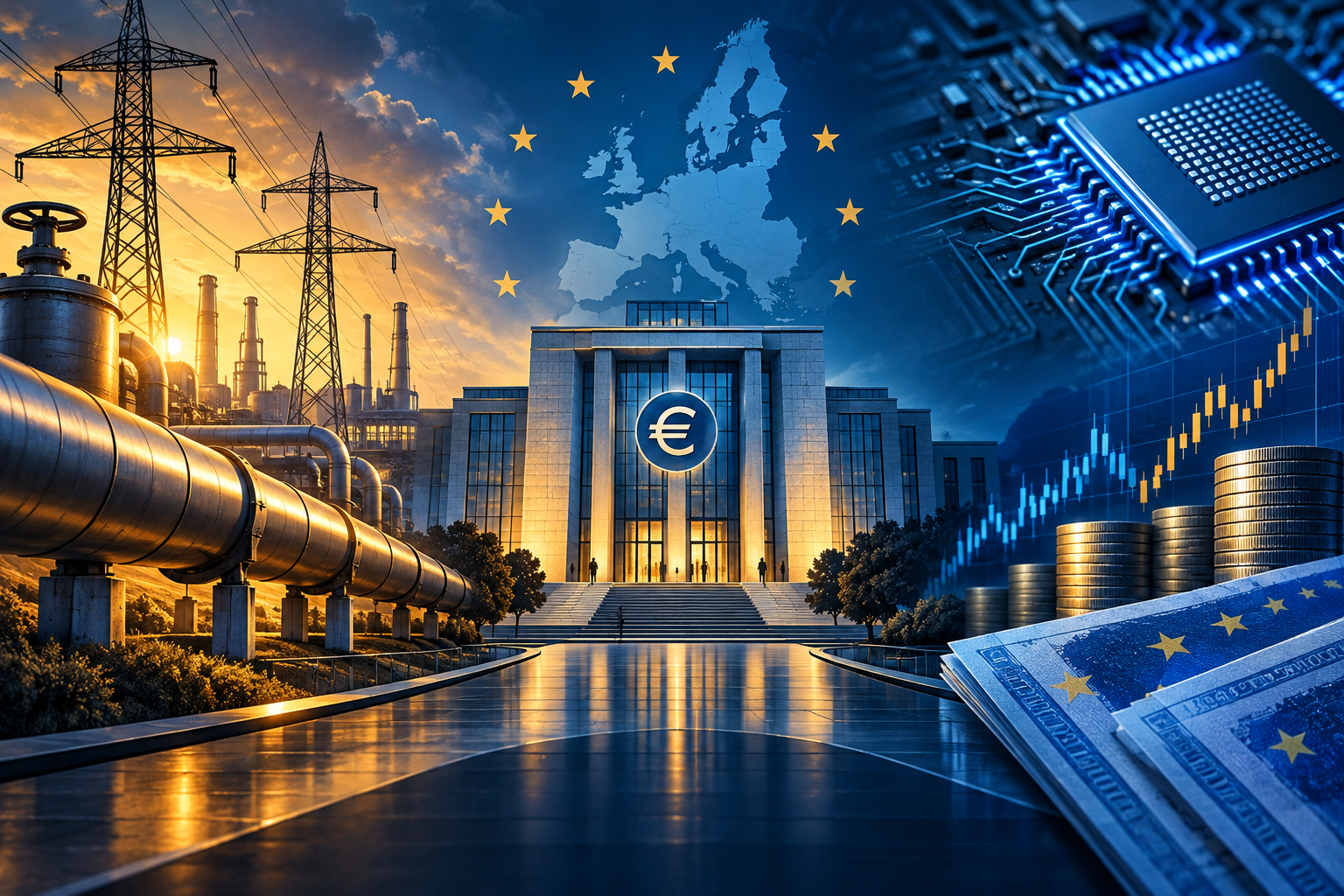
European Central Bank chief economist Philip R. Lane said energy prices had exceeded the bank’s baseline assumptions, but their wider impact on inflation remained uncertain, in an interview with Ansa published by the ECB on 6 October 2026. He identified the energy shock as the principal driver of interest-rate decisions, while warning that rising long-term borrowing costs could restrain the European economy.
Lane’s account sets out competing pressures on monetary policy: more expensive energy is pushing up prices, while tighter financing conditions could weaken activity and reduce inflation. He did not commit to a particular next move in policy rates.
BharatVox Graphic
Competing pressures on ECB policy
Energy shock
Inflation pressure
Lane said energy prices exceeded baseline assumptions, while wider pass-through remained uncertain.
Higher long-term yields
Growth restraint
Lane said externally driven increases in borrowing costs would, on their own, weaken activity and lower inflation.
Higher energy prices do not settle the scenario
Lane cautioned against treating higher oil and gas prices as proof that the economy had entered one of the bank’s adverse scenarios. Those exercises combine several assumptions, including how quickly energy costs spread through the economy and how strongly they generate subsequent wage and price increases.
So far, he said, strong second-round effects had not emerged. Energy prices alone therefore could not determine which scenario best described conditions; the bank needed to assess the broader transmission of the shock.
He said fears of substantial economic damage when the Middle East conflict erupted in the spring had not visibly materialised over the summer. In his account, a temporary easing in energy prices and improved sentiment following an Iran–United States memorandum of understanding had helped activity. Renewed price increases and uncertainty over the conflict’s duration now raised questions about whether that support would persist.
AI investment supports trade—and raises financing pressures
Lane described artificial intelligence as a major force shaping the global economy. Investment in the technology was supporting trade in semiconductors and other inputs, with European companies participating in those supply chains.
But he also linked the US investment surge to increased long-term debt issuance by companies and identified it as one contributor to higher bond yields. The ECB, he said, evaluates the full range of financing conditions rather than looking only at its own policy rate.
Higher long-term interest rates driven by global rather than European developments would, on their own, slow the European economy and lower inflation, Lane said. The bank would examine lending and business surveys to assess the consequences for investment and employment.
AI research was spread across the ECB and national central banks, including the Banca d’Italia, rather than confined to a single task force. Specialists were studying employment, banking and investment effects. Lane pointed to his earlier speech, “AI and the euro area economy”, as a synthesis of that work, without offering a new numerical estimate of its productivity or inflation impact in the interview.
Fiscal support faces a change after 2026
Lane said public spending had helped the economy withstand the energy shock. He highlighted Germany’s infrastructure and defence programme, alongside relatively strong public investment in countries including Italy.
He described 2026 as the final year of the Next Generation EU programme and cautioned that the fiscal contribution to growth in 2027 and 2028 would differ from this year’s. He also saw some improvement in European AI-related investment, though not a boom comparable with that in the United States.
On household relief, Lane favoured assistance concentrated on people with low incomes. Broad fiscal expansion, he argued, would add demand and make a timely return to the ECB’s 2% inflation target harder.
Italian wage gains are a forecast, not an outcome
Lane said the ECB’s September projections envisaged Italian wages rising faster than inflation in 2027 and 2028. That would allow some recovery in living standards after workers’ incomes failed to keep pace fully with the current energy-driven price surge.
He also warned that wage growth needed to be considered alongside competitiveness, recruitment and the ability to attract foreign investment. As a major energy importer, Europe faced a collective income loss from higher energy prices, he said; shielding every worker completely from that loss was not possible.
His argument again distinguished targeted protection for low-income households from economy-wide compensation. The projected improvement in Italian purchasing power remained conditional on the economic outlook rather than a guaranteed result.
Governments urged to plan for higher debt costs
Defending the role of monetary policy, Lane said both excessive inflation and inflation below target created problems. He recalled an earlier tightening cycle in which the policy rate reached 4%, followed by reductions to 2% as inflation conditions improved. Those figures described the earlier cycle, not a new rate announcement.
For governments preparing their 2027 budgets, he urged attention to borrowing costs and growth over the next five to ten years, rather than only immediate financing needs. Budgets, he said, needed to incorporate realistic assumptions about future interest rates.
Higher financing costs also strengthened the case for reforms to lift economic growth, Lane argued, citing recommendations associated with Mario Draghi and Enrico Letta.
Source document: European Central Bank, “Philip R. Lane: Interview with Ansa”, published 6 October 2026. The discussion covers conditions in 2026 and the outlook for 2027–28. https://www.ecb.europa.eu//press/inter/date/2026/html/ecb.in261006~bc94400297.en.html
Who's who
Philip R. Lane
ECB chief economist and Executive Board member
Fact-check this story · Source: European Central Bank: Philip R. Lane: Interview with Ansa. This AI-assisted account is based on the linked source, not independent on-the-ground reporting by BharatVox. Any opinion is separately labelled.
Join the conversation (0)
Sign in to share your view on this story.