SPACE EXPLORATION
Japan’s MMX mission targets first samples from Mars’ moons
Japan has reportedly launched its MMX spacecraft on a five-year mission to explore Mars’ moons. A French-German rover will assess conditions on Phobos before a lander attempts to collect at least 10 grams of material for return to Earth in 2031.
BharatVox ·
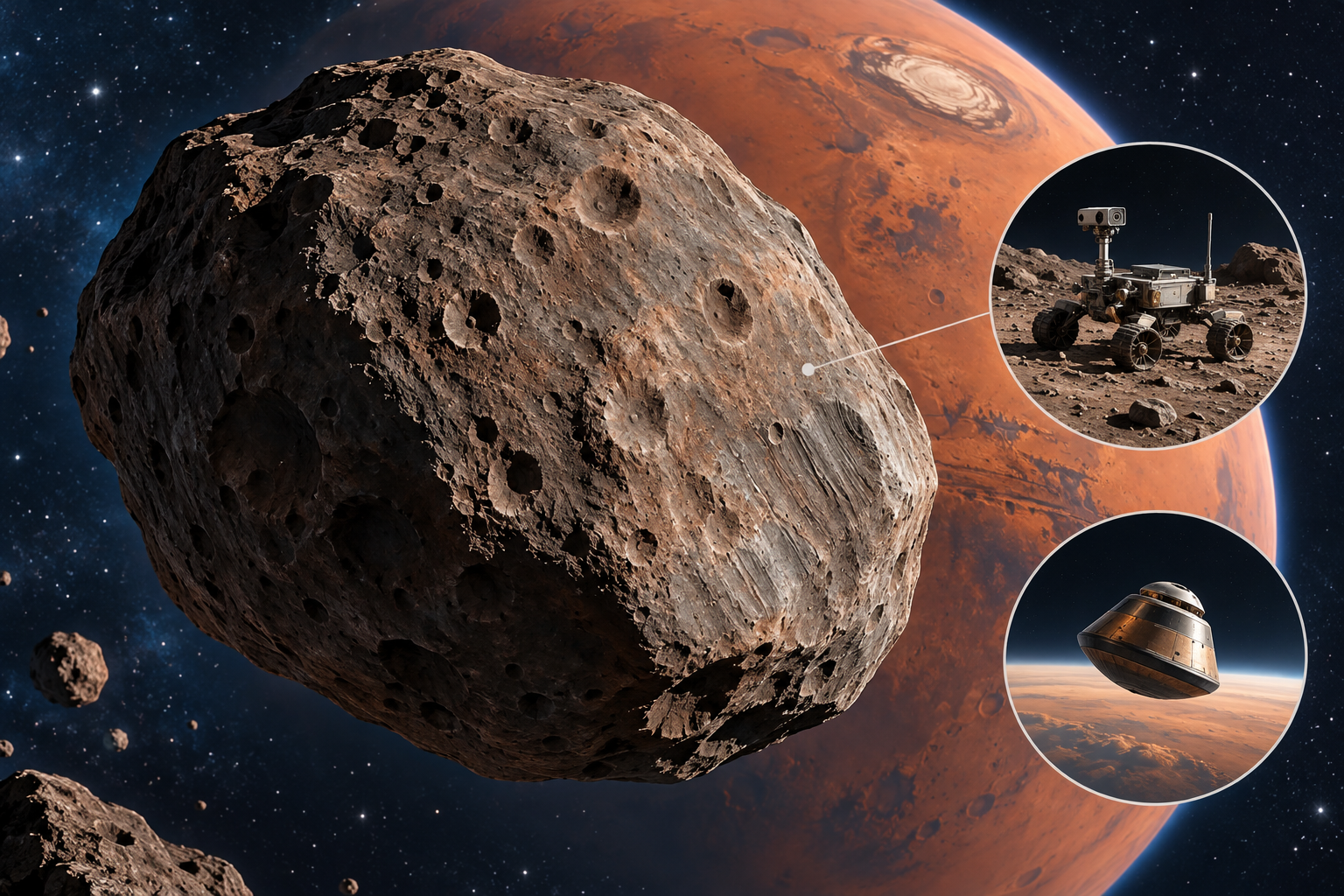
Japan has launched a spacecraft towards Mars to attempt something no mission has yet achieved: collecting material from one of the planet’s moons and bringing it to Earth, according to The Economic Times. Led by the Japan Aerospace Exploration Agency (JAXA), the five-year Martian Moons Exploration mission, or MMX, involves five space agencies and targets a sample delivery in 2031.
The report places the pre-dawn launch at Japan’s Tanegashima Island spaceport. Its precise timing is unclear: the account describes a Tuesday launch, while the article’s publication timestamp is Monday, October 19, 2026.
The reported $578 million mission centres on Phobos, the larger and closer of Mars’ two moons. The roughly five-ton spacecraft is expected to reach Mars by late summer 2027, match Phobos’ orbit and deploy a small rover before attempting its own brief landing.
BharatVox Graphic
MMX’s planned route to a sample return
- 1
Reach Mars
Late summer 2027
The spacecraft is expected to arrive and match Phobos’ orbit.
- 2
Scout Phobos
Before sampling
Idefix is designed to survey surface conditions over 100 days.
- 3
Collect material
Late 2028 or 2029
A two-hour landing aims to retrieve at least 10 grams.
- 4
Head for Earth
2030
Departure follows sampling and planned flybys of Deimos.
- 5
Deliver samples
2031
The return capsule is intended to arrive in the Australian desert.
A slow-moving scout for a difficult landing
The French-German rover Idefix, named after the dog in the Asterix comics, is approximately the size of a microwave oven. It is designed to drop onto Phobos and bounce for several minutes in the moon’s extremely weak gravity before settling.
Its four wheels can help it turn upright after an upside-down landing, but that ability has limits. French Space Agency official Julien Baroukh said soft ground or a position trapped between rocks could prevent recovery. Once its solar panels open, the rover will no longer be able to right itself.
Idefix will therefore travel at just 1 millimetre per second during a planned 100-day reconnaissance. Its observations are intended to help Japanese mission controllers select ground that is neither too powdery nor too rugged for the main spacecraft.
Two hours to collect a sample
The main spacecraft, equipped with four landing legs, is scheduled to descend onto Phobos in late 2028 or 2029. It will have about two hours on the surface to collect at least 10 grams of material using drilling and suction equipment before lifting off again.
After sampling, MMX is expected to examine Deimos, Mars’ smaller moon, through a series of flybys. Departure from the Martian system is planned for 2030, followed by delivery of the samples to the Australian desert in 2031.
Japan brings experience from two successful asteroid sample-return missions. The destination nevertheless presents a significant challenge: neither Phobos nor Deimos has hosted a successful surface mission, and previous Russian attempts to explore Phobos failed.
What material from Phobos could reveal
Phobos is an irregular body roughly 22 kilometres across. Studying its material could help distinguish between two explanations for the Martian moons: formation from debris after an ancient impact on Mars, or capture of passing asteroids by the planet’s gravity.
Scientists also expect that Phobos may hold material originating on Mars. If that expectation is borne out, one collection could offer evidence about both the moon and its parent planet. These are scientific objectives, not findings already established by the mission.
NASA’s acting planetary science director, Lindsay Hays, said the results could inform future Mars exploration, including astronaut missions.
International funding and another race to return samples
The reported contributions are $350 million from Japan, $87 million from NASA, about $68 million from the French Space Agency, about $56 million from the German Space Agency and roughly $17 million from the European Space Agency.
China is also planning a Mars sample-return launch in 2028, with material due back in 2031. NASA, meanwhile, is still considering how to retrieve more than 30 sample tubes collected by its Perseverance rover. Japan’s lunar target and China’s planetary target are different, but their planned return dates could put both missions in contention to deliver the first samples from the Martian system.
Fact-check this story · Source: The Economic Times: Japan launches spacecraft to moons of Mars. This AI-assisted account is based on the linked source, not independent on-the-ground reporting by BharatVox. Any opinion is separately labelled.
Join the conversation (0)
Sign in to share your view on this story.