SPACE EXPLORATION
Japan’s MMX launches to bring Phobos dust back to Earth
Japan’s MMX spacecraft has launched on a mission to collect 10g of material from Phobos and return it to Earth in 2031. Scientists hope the samples will distinguish between competing explanations for the origins of Mars’s moons.
BharatVox ·
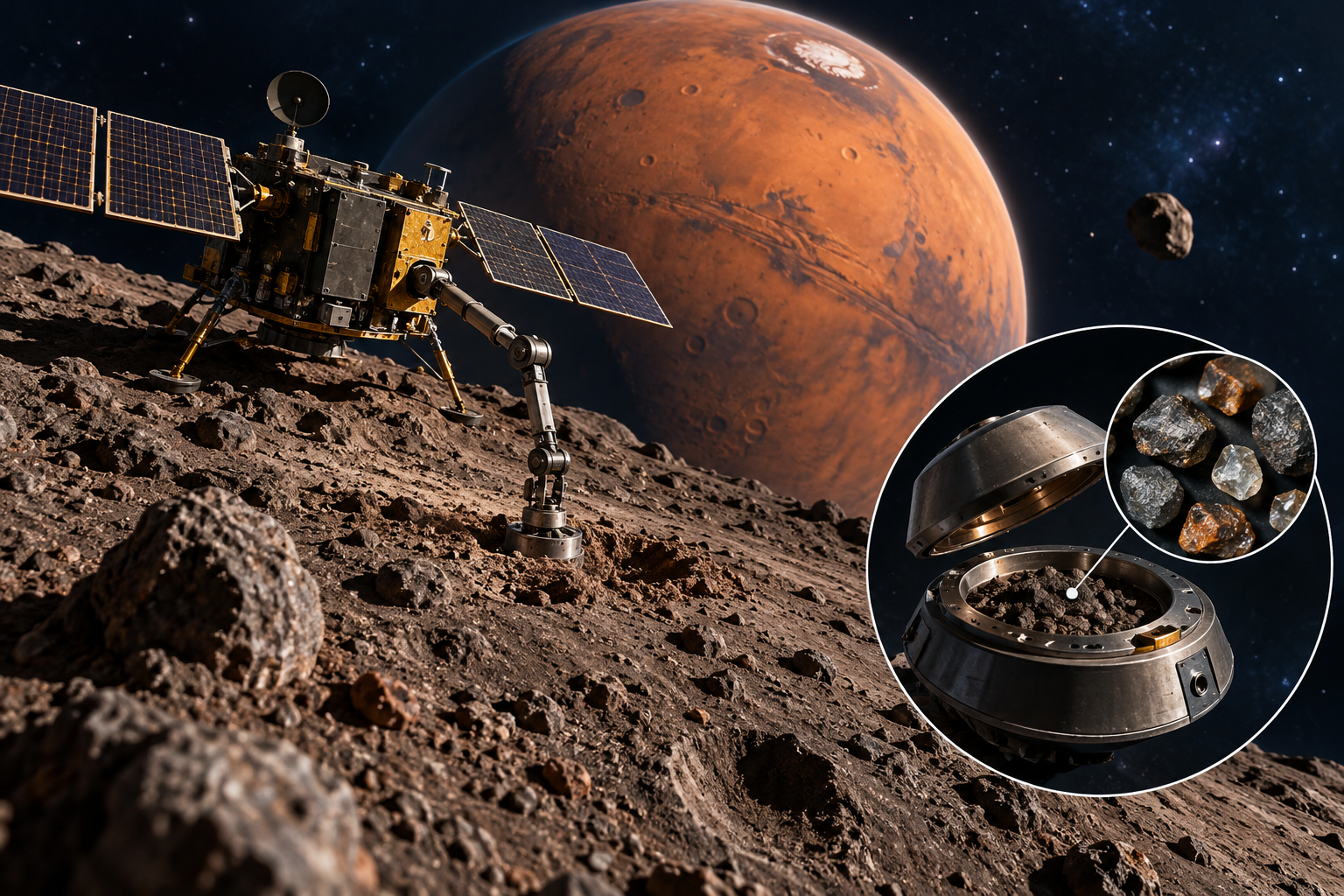
Japan’s MMX spacecraft has launched from Japan towards Phobos, the larger of Mars’s two moons, on a mission to collect 10g of surface material and bring it to Earth in 2031, BBC News reported. The Japanese space agency-led mission is scheduled to reach Phobos in August 2027.
If successful, it would be the first mission to return a collected sample from Mars or either of its moons. Laboratory analysis could help resolve whether Phobos and its smaller companion, Deimos, formed from debris thrown up by an impact on Mars or were asteroids captured by the planet’s gravity.
BharatVox Graphic
How MMX plans to collect its sample
- 1
Study the moons
Approach
Observe Deimos before focusing on Phobos, with arrival scheduled for August 2027.
- 2
Deploy a rover
Reconnaissance
Explore Phobos’s terrain and scout a landing site for the spacecraft.
- 3
Sample the surface
Collection
Use a robotic arm and two samplers to collect a target of 10g of material.
- 4
Deliver to Earth
Return
Return the sealed capsule to South Australia’s Woomera desert in 2031.
A difficult landing on a small moon
MMX will study Deimos as it enters the Mars neighbourhood before concentrating on Phobos. Both moons are small and irregularly shaped: Phobos measures roughly 20km across, while Deimos is about 10km across.
The mission plans to deploy a small rover to examine the terrain and scout a landing site for the main spacecraft. Sara Russell of the Natural History Museum, the mission’s deputy for sample analysis, said no rover had previously landed on a moon this small.
Phobos’s weak gravity, combined with the much stronger gravitational pull of nearby Mars, makes placing a rover on its surface particularly challenging, Russell explained.
After the rover’s reconnaissance, the spacecraft is intended to touch down and use a robotic arm and two samplers to collect dust. The material will be sealed in a small return capsule, with a landing planned in South Australia’s Woomera desert in 2031.
What 10 grams could reveal
The sample target is modest in weight but potentially substantial in scientific value. Chrysa Avdellidou of Leicester University, who is working with the mission, explained that researchers can conduct several studies on individual grains rather than needing large quantities of material.
Scientists will examine the dust’s chemistry and mineral composition to test the two principal explanations for the moons’ origins. One holds that an early collision blasted material from Mars that subsequently formed the moons. The other proposes that Mars captured two wandering asteroids from the outer Solar System.
Russell expects those scenarios to leave distinctly different signatures in the samples, allowing researchers to identify which explanation the material supports.
There could also be traces of Mars itself in the capsule. Impacts on the planet may have thrown grains onto nearby Phobos, where they could have become embedded in its surface. Russell said any such material would offer direct clues to Mars’s composition and history, although its presence in the returned sample is not assured.
The wider effort to return Martian material
NASA’s Perseverance rover has been exploring Mars since 2021, collecting samples and storing them in canisters. The report described the separate NASA–European Space Agency Mars Sample Return project, intended to retrieve those canisters, as effectively cancelled after the US Congress halted its funding.
China is planning a Mars sampling mission for launch in 2028, with an intended return of material to Earth in 2031. Those dates remain mission plans rather than completed milestones.
Researchers already study rare Martian meteorites: fragments ejected from Mars by asteroid impacts that eventually reached Earth. But exposure to Earth’s air, water, soil and dust contaminates those rocks. Returning protected samples directly from a celestial body would allow scientists to examine material without that same history of terrestrial exposure.
Who's who
Sara Russell
Natural History Museum researcher and MMX deputy for sample analysis
Chrysa Avdellidou
Leicester University researcher working with the Japanese mission
Fact-check this story · Source: BBC News: Mission blasts off for Mars to grab a piece of its moon. This AI-assisted account is based on the linked source, not independent on-the-ground reporting by BharatVox. Any opinion is separately labelled.
Join the conversation (0)
Sign in to share your view on this story.