AIR QUALITY
Mumbai Air Pollution: Weak Winds Put Coastal Shield to Test
The Bombay High Court has sought enforcement details from Mumbai authorities as experts link worsening air to sluggish winds and multiple emission sources. Claims comparing Mumbai with Delhi need care: readings on US and Indian AQI scales are not directly comparable.
BharatVox ·
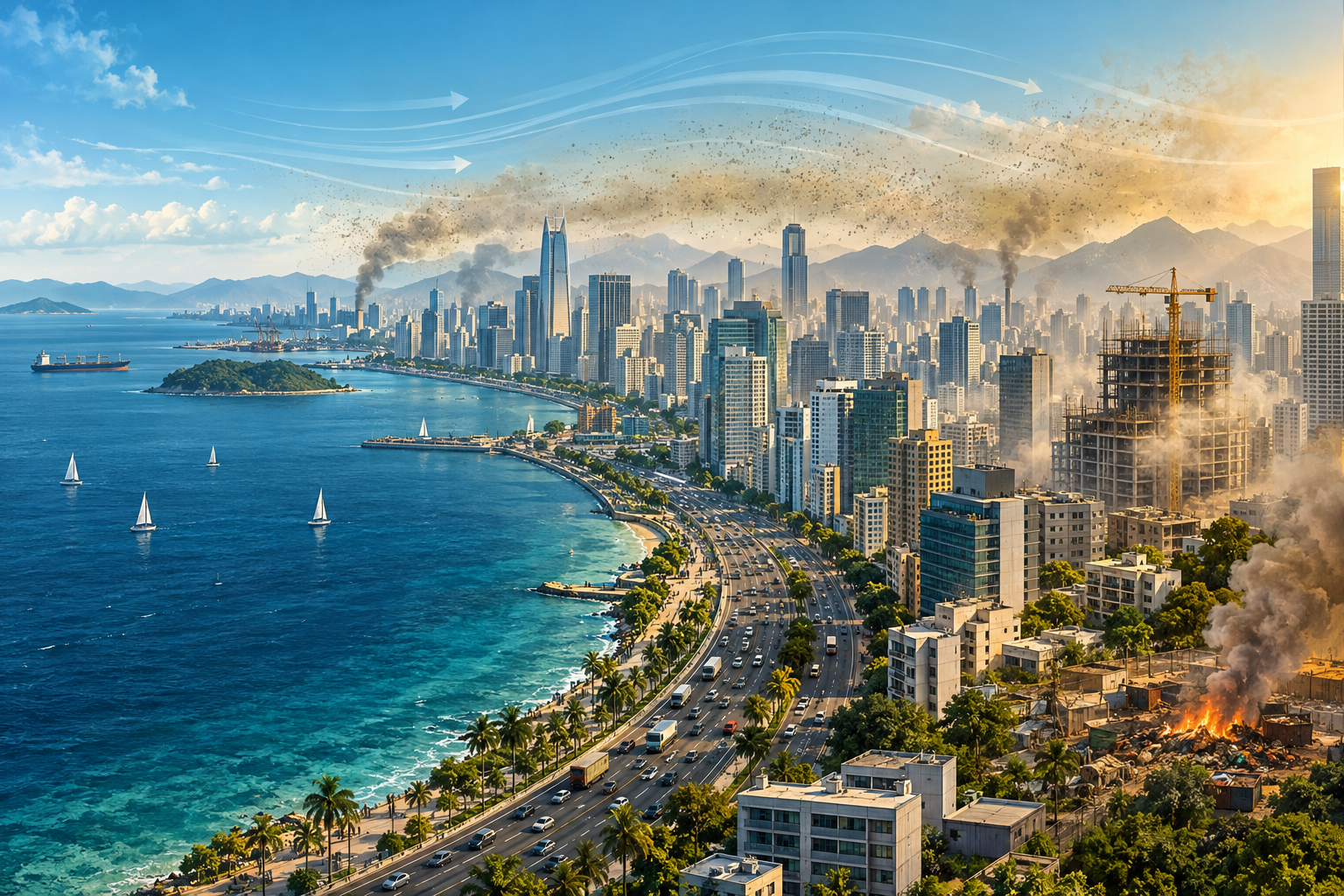
The Bombay High Court has directed Mumbai’s police, the Brihanmumbai Municipal Corporation and the Maharashtra Pollution Control Board to explain how they are enforcing pollution-control and firecracker orders, with their measures due to be presented at an October 26 hearing. The October 21 direction comes as weak winds and emissions from several sources put the coastal city’s natural ventilation under strain.
India Today reported on October 24 that the court had characterised the situation as an emergency and questioned how Mumbai’s air could be worse than Delhi’s. Experts interviewed by the outlet pointed to slower winds, construction dust, vehicle exhaust, agricultural burning, open garbage fires and firecrackers—not a single proven cause.
The AQI comparison needs a common scale
The report cited an October 15 IQAir ranking that placed Mumbai first among Indian cities and fifth globally, with a reading of 152. That figure used the US Air Quality Index scale. The Central Pollution Control Board’s citywide reading on the same date was 98 on India’s National AQI scale.
Those numbers are not directly comparable. The index used, pollutants measured and monitoring locations all matter. The ranking is a dated snapshot, not evidence that Mumbai’s air is continuously worse than Delhi’s; the two Mumbai readings alone do not establish a like-for-like comparison with the capital.
Why the sea breeze is not enough
Gufran Beig, chair professor at the National Institute of Advanced Studies on the IISc campus, explained that Mumbai’s coastal winds ordinarily help carry pollutants away. When that airflow slows, emissions can accumulate rather than disperse. Even a relatively small period of stagnation can weaken the city’s usual advantage, he said.
Beig also suggested that changing weather patterns, including an anticipated El Nino influence, could affect winter temperatures and pollution dispersal. This was an expert assessment of a possible weather contribution, not a measured attribution of the current pollution episode.
He raised a separate concern about monitoring: readings at particular locations and heights may not fully represent the haze experienced nearer the ground. That concern does not, by itself, establish that official instruments are inaccurate.
Farm-fire contributions remain dependent on winds
Beig identified agricultural fires inland as a possible contributor. He said winds during October and November generally arrive from Mumbai’s northeast and could transport emissions from areas such as Madhya Pradesh and Jharkhand. But he cautioned that the distances are substantial and that the effect depends on wind speed, direction and how long pollutants remain airborne.
His assessment of the current wind pattern did not support pollution from Punjab, Haryana or Delhi reaching Mumbai. That is a seasonal assessment, rather than proof that long-distance transport from northern India can never occur.
Within Maharashtra, crop-residue burning generally occurs during February–May and October–November, with timing varying by crop and region. Beig had previously argued that changing climatic conditions were making the effects of this longstanding practice more noticeable. The reporting does not establish what proportion of Mumbai’s current pollution comes from farm fires.
Waste fires expose gaps beyond city limits
Awaaz Foundation founder Sumaira Abdulali identified open waste burning around Alibaug and other rural areas near Mumbai as another concern. She said gaps in formal waste collection and disposal leave residents burning rubbish beside roads and on open land.
The report also identified Bhiwandi in Thane district as an area of concern. Abdulali’s sensor observations indicated severe pollution close to garbage fires, but such local readings should not be treated as Mumbai-wide exposure measurements. Limited official monitoring in rural areas makes the wider burden harder to assess.
Firecracker enforcement faces court scrutiny
Abdulali said tests had detected toxic heavy metals in firecrackers, including products sold as green crackers, and called for a complete ban. The reporting did not identify the test methodology or establish that every product carrying that label had been tested.
In an October 21 letter to Maharashtra Chief Minister Devendra Fadnavis, she alleged continued firecracker use despite court restrictions. The letter referred to a prohibition on firecrackers in public spaces, including roads and footpaths, during festivals in 2026, alongside directions for police to measure noise levels and act on violations.
The October 26 hearing is expected to bring the authorities’ enforcement measures before the court. No detailed response from the police, BMC or pollution board was included in the report. The immediate accountability question is what action those agencies have taken against the emission sources and violations covered by the court’s orders.
Who's who
Gufran Beig
Atmospheric scientist and chair professor at the National Institute of Advanced Studies
Sumaira Abdulali
Founder of the Awaaz Foundation
Devendra Fadnavis
Maharashtra Chief Minister and recipient of Abdulali’s enforcement letter
Fact-check this story · Source: India Today: Mumbai has the sea, so why is its air now worse than gas chamber Delhi's?. This AI-assisted account is based on the linked source, not independent on-the-ground reporting by BharatVox. Any opinion is separately labelled.
Join the conversation (0)
Sign in to share your view on this story.